Ch-Ch-Ch-CHANGE. Something to embrace, or run and hide from? Change is an inevitable part of life that motivates and challenges some but causes anxiety for others. No matter how we feel about change it is part of our personal life and our professional world and WILL BE encountered. Adapting to change is key for us as individuals and critical for businesses, allowing us to remain relevant and competitive.
As an employee, take the time to understand how to deal with change that is on the horizon. Being open to change can enhance your ability to communicate, help you work as a valuable team member while adapting to the changes, and strengthen your professional bond with coworkers. This demonstration of adaptability also shows your superiors that you can be relied upon.
During a season of change, it will be crucial to maintain communication with your direct supervisor who can help you navigate new tasks or processes. Take time to ask the questions that need to be asked. Even simple questions can give you a better understanding of how to complete any new tasks or processes and better understand why the changes are necessary. If new technology or skills are required, take initiative to look for ways to become more comfortable with them, even if outside of your work hours. This positive outlook on workplace changes will influence your ability to accept and adapt to them making it easier to accommodate change as it is happening. The goal is to be able to continue performing at an optimal level.
If the challenge of change is taking its toll on you, schedule a personal day to recharge and gain the energy needed to implement those changes effectively. This habit can limit the potential for burnout and help you come back to the work environment with a renewed sense of productivity. Dealing with change can be a challenge, but remember, all change becomes routine with time.
“The measure of intelligence is the ability to change” ~ Albert Einstein
Melanie Eby Manager of Administration & Human Resources
We spend roughly 90% of our lives indoors. Studies suggest that 90% of our thoughts are unconscious. So, this begs the question: Does the quality of a space influence cognition? The answer, as you might imagine, is yes. The three main ways through which space can affect our thinking are color, height, and light.
Color
We’ve all heard about the ability of color to affect our mood. Reds energize, blues and greens are calming and relaxing, yellows help creativity, and so on. But you may be surprised to learn that the color of the space you are in can impact your thinking.
In 2009, psychologists at the University of British Columbia set up an experiment to see how color can influence imagination. They recruited six hundred research subjects and performed a series of basic cognitive tests against red, blue, or neutral backgrounds. What they discovered was pretty impressive.
When subjects were tested with the red background, they performed much better with tasks that required accuracy and attention to detail. Scientists believe this is because we are conditioned to associate red with danger, which makes you much more alert and vigilant.
These same subjects, when tested with the blue background, performed much better with tasks that required more imagination and creativity. In fact, subjects were able to come up with twice as many creative solutions to their tasks in the blue condition than they were in the red. Scientists believe that this is because blue reminds us of open skies and the expansive ocean. It soothes our mind and allows us to think more openly about what is possible rather than what is right in front of us.
Height
We all tend to prefer big spaces. We like big, tall ceilings in our living rooms, vaulted ceilings in our bedrooms, and big corner offices. So, Joan Meyers-Levy conducted an experiment at the University of Minnesota’s Carlson School of Management in which she examined how ceiling height impacts the way people think, feel, and act. The idea for the experiment came to her while she reflected on how boarding a flight affected her mood.
In her study, participants were asked to complete a series of different tasks. Some required focus and attention to detail while others relied more on abstract thinking. She found that subjects placed in a room with a higher ceiling were able to complete tasks requiring abstract thinking much faster. Test subjects in the room with the lower ceiling performed better on tasks that required more focus and attention to detail.
Light
The visual environment and access to natural light are also extremely important to occupants’ mental health and performance.
A famous study, by social scientist Robert Ulrich, investigated the effects that windows and natural light had on patients recovering from the same type of surgery. The setting for the study was a hospital with patient rooms on either side of a corridor. Rooms on one side the corridor had windows with views of plants, trees, and lots of natural light. Rooms on the other side had windows facing the wall of a neighboring building. What Ulrich discovered was that the patients recovering in the rooms with abundant natural light and views of vegetation had shorter stays and required much less medication than their counterparts on the other side of the corridor.
In a study sponsored by the state of California, researcher Lisa Heschong found that kids in classrooms with abundant natural light performed as much as 25% better on standardized tests than kids in classrooms with little to no natural light. Large openings with plenty of diffused light and views of people, plants, and other objects in the distance were found to be ideal. Classrooms with unshaded direct sun from south or east-facing windows were shown to contribute to poor student performance, most likely from the excessive glare and heat. Blinds and curtains in classrooms were also very beneficial, since they provide teachers with a simple way to control distractions or glare.
The buildings we inhabit affect us profoundly whether we realize it or not. Most of that influence happens at an unconscious level. As designers, we need to start thinking not only about the aesthetics of the space we create, but also of the invisible emotional connection between those spaces and their occupants.
Several weeks ago, we introduced the idea that there are better ways to select a Contractor than to ask Contractors to submit bids at the end of the contract document phase. In previous posts, we discussed the pros and cons of design/build and Construction Manager as Constructor (CMc). We complete this series by discussing selecting a Contractor through negotiation.
Unlike Design/Build and Construction Management, there is no industry-defined method or set model of contracts to define a negotiated selection of a Contractor. In fact, what type of contract to use should be part of the negotiation.
The primary reason to select a Contractor through negotiation is that the Owner has an established relationship with a Contractor. The Contractor may have built previous buildings for the Owner. Often this means the Owner trusts that the Contractor understands their expectations for cost, schedule, and quality. What remains is to determine what is the best contractual relationship between Owner, Contractor, and Architect. Should it be design/build where the Architect works for the Owner? Should the Contractor function as Construction Manager, taking on preconstruction responsibilities for budget, schedule, and constructability reviews? A review of the pros and cons for each method described in our previous posts will provide guidance when addressing these questions.
The other type of negotiated process occurs when the Owner does not have an existing relationship with a contractor, but still wants the contractor selected early in the project. Blueline has a process for this that provides the Owner with both quantitative and qualitative information for decision-making. Typically, we complete a conceptual design that includes a detailed floor plan, building elevations, 3-D views, a preliminary site plan and an outline narrative describing the materials, systems, and performance requirements of the building. This conceptual design package is then distributed to several (we recommend three, but no more than five) Contractors. Each Contractor is asked to provide the following information related to the conceptual design:
A non-binding conceptual budget for the design
A non-binding schedule for the project
A list of potential cost savings or areas where design decisions will have significant cost impact
Examples of similar projects the Contractor has completed
Three references from the Owner of similar projects
Demonstration of their ability to provide preconstruction budgeting and scheduling services
In addition, we ask the Contractors to provide the following data:
A stipulated, binding fee for the work
A list of items they typically include as part of their general conditions
Their bonding rate and capacity. (Even if project does not need to be bonded it speaks to the volume, quality, and performance of company over time.)
Their cost for preconstruction services and the number of budgets and updates they are willing to provide.
Based on these answers, one or more of the Contractors is brought in for a face-to-face interview. In this interview, the team can ask questions that shine a light on their project management style. Typical questions can include, but are not limited to:
What do you believe is critical to delivering a project on-time and on-budget?
How will you choose sub-contractors for this project?
How do you handle conflict among project team members?
What is distinctive about your company?
This process can take four to six weeks, but if completed before detailed design work is started, can provide tremendous value to the Owner. When the Architect and Contractor work as a team for the good of the Owner, projects go from good to great. Let Blueline help you negotiate to find the right contractor for your project. Contact us at www.blueline.team.
Randy Seitz President | Client Service Leader | Architect
Imagine you have a brand-new space that you and your team have poured your hearts and souls into. The programming has been meticulously analyzed. The views have been optimized, and the finishes are in pristine condition. You start imagining the growth and fellowship that is about to take place between these freshly painted walls. Then it hits you, while you know this new building like the back of your hand, will your visitors feel just as comfortable?
Most of us can agree that navigating a new space can create some anxiety. “Will I be able to get where I’m going?” Will I belong?” It is a designer’s job to help ease some of these anxieties and curate a positive experience for all visitors. Signage and furniture tend to be afterthoughts, but it is the furniture and signage that send the clearest message to the visitors of a space. Let’s look at what subconscious messages we are sending.
Signage – “We’ve been expecting you”
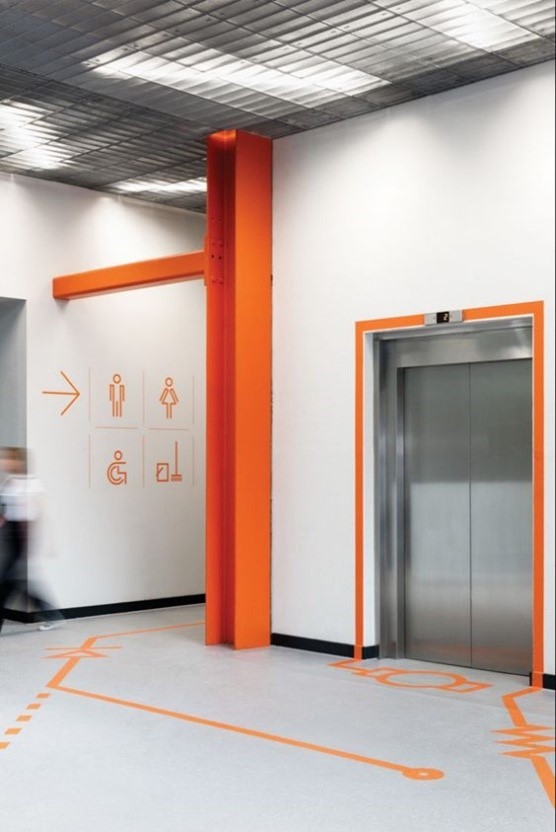
When a complete signage package is integrated into the initial design of your space, not only does it create an overall cohesive look, but it also sends the message to visitors that this space was created with them in mind. It is important to remember that not all visitors have the same needs. You will have visitors of all ages and backgrounds that may not read a sign the same way. The use of pictures and color-coded wayfinding are a great universal way to guide people. Nothing creates more inclusivity than sending the message “We’ve been expecting you.”
Furniture- “We are here to meet your needs
Upon entering a space, visitors should quickly “feel” the type of space they are entering by the furniture arrangements. Imagine you have just walked into a 30’x30’ room. This room has a concrete floor, white walls, and is completely empty. You’re asking yourself, “What do you do in this space?” Most likely you’re looking around for visual cues on how to respond to your surroundings. Then, imagine you have walked into a 30’x30’ room with a concrete floor and white walls, only this time you see a cluster of café tables and stools all centered around a small barista station. The tables and chairs tell you this is a place to socialize, and the barista station tells you the function of the space.
We can continue to curate the experience by furnishing the space with a combination of table and chair styles. Bar height tables and low back stools encourage interaction between guests by placing seated guests and standing guests at eye level. The low back stools allow for easy movement from left to right and from standing to sitting. By including a seating arrangement with dining height tables and higher backed chairs, you are inviting your guests to spend more time in the space. The variation in styles sends the message to guests that “we are here to meet your needs.”
Through thoughtful furniture arrangements and clear messaging, you are putting your visitors’ needs first, thus communicating a message of acceptance and hospitality.
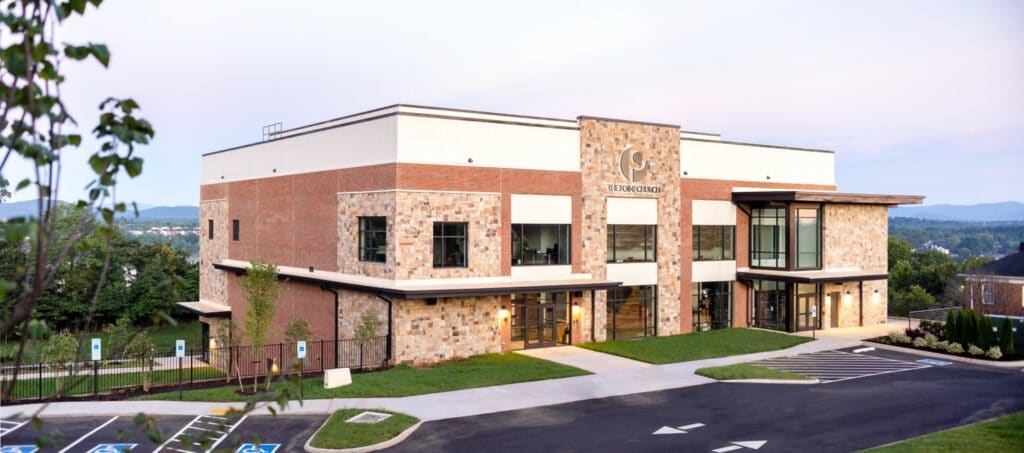
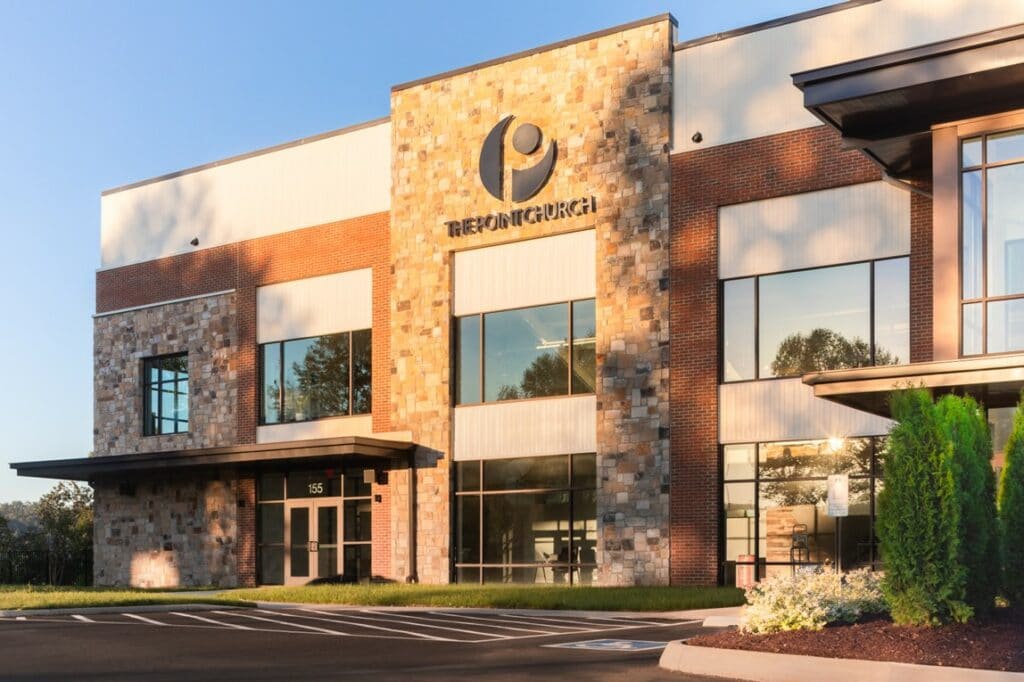
This is the second part of a conversation I had with Jessie Wilson, Director of Operations for The Point Church in Charlottesville, VA, about their journey going from portable to permanent. After spending 10 years operating as a portable church, The Point acquired property and built from the ground up, opening their permanent home in September 2020. Part 1 covered their time being portable and the decision-making process to move toward a permanent home. In this post, we discuss life in their new facility.
You’re now in your new home. Overall, how has the experience been?
As somebody who has overseen operations for the church for the last six years, it’s a whole new world. It’s definitely a mind shift to go from thinking, “Alright, I’ve got two hours of set up, two hours of teardown, with two church services in between” to being able to direct most of your focus to the service itself.
Even for our congregation, it feels like home; like we’ve arrived. And they have the sense that it’s our church–it’s not Monticello High School that we put our church into for a few hours on Sundays—it’s our church. So, it gives ownership to our people. It’s awesome. I don’t know any other way to say it other than it’s awesome.
How has volunteering changed?
There’s still some amount of set up and tear down, but it’s looks very different. It allows people to focus more energy on their specific gifts.
We now have a building to maintain which has allowed us to start a mentorship program where we pair older members that have certain gifts or skillsets with younger members. For example, in setting up our Kidspoint environments, there was a great opportunity for the younger guys in our church to learn from our older members and get hands on experience in building furniture. Additionally, a Christ-based relationship is formed, where later on, the younger member can lean on the older one for advice in dealing with issues that may come up in their lives. This was a huge opportunity for our church body to have a great mentorship program where you don’t even realize you’re in a mentorship program. You’re just hanging out with the guys.
Have you had any unexpected benefits from having a permanent home?
There have been a lot of things. I think the overall thing that I’ve been impressed by and have loved so much is the ownership that our church body has taken in it.
We’ve had a number of opportunities that having a permanent building has given us. For example, a couple of months ago, we teamed with local restaurants and fed twelve hundred meals to health care workers on a Wednesday night—the building allowed us to do that.
Sometimes people will come and sit in the parking lot simply to enjoy the view.
We’ve had people come to us asking for help, which we didn’t experience before because outside of Sunday mornings when our signs were out and visible, people didn’t know where to find us. Having a permanent facility has allowed us to become more of a fixture in the community. For instance, a couple of months ago there was a lady whose car broke down. Having seen the sign on our building, she knew that we were here, and we were able to help her. So, it just expanded our ministry to another level that we didn’t have before.
What advice would you give another church that was considering a permanent home?
Do it. I think it’s a great move. It redirects the energy that you’re using on setup and teardown and the other aspects of being portable into other areas and allows you to expand your ministry in other places.
Don’t build to accommodate your current attendance—always project for growth.
Use the move as an opportunity to build off past experience while still maintaining your identity. As a portable church, we learned to be scrappy out of necessity, and I hope we never lose that. At the end of the day, we’re still The Point.
Blueline has been honored to serve The Point and are excited to hear about the opportunities and positive outcomes that being in their new building has given them.
It’s a natural progression for a young church. After forming, one of the early needs is finding a place to meet that allows the church to minister to the community and hopefully grow. Historically, schools have provided a nice fit, in that they’re usually empty on Sundays when a church would need them, they have rooms that lend themselves nicely to worship and children’s ministries and are a cost-effective way to allow a church to grow in a fiscally responsible manner.
Each church is different, but for most, the next logical step is to move on from the portable setup to a more permanent one – whether converting an existing building to a church or building new from the ground up. I recently spoke with Jessie Wilson – Director of Operations for The Point Church in Charlottesville, VA about their journey going from portable to permanent. After spending 10 years operating as a portable church, The Point acquired property and built from the ground up, opening their permanent home in September 2020.
You’ve been in your new facility for nine months now. After having a little time to reflect, when you look back, what is your overall perception of being portable.
There were challenges. Our venues were great to be in but having your 24/7 facility in five trailers Monday through Saturday didn’t allow for your equipment and belongings to last very long. With constant packing and unpacking, things wore out…every week it seemed like we were replacing something. So, the list of complications in doing portable church could be long. On a positive note, however, it also makes you scrappy—which is something that I hope we don’t lose going forward—and it made our volunteer teams a lot tighter than they would’ve been otherwise.
With portable church relying so heavily on volunteers, was it difficult to maintain enthusiasm?
One of the things that is very important to us is that you serve using the gift(s) that God has given you. Now, your gift can be in setup and teardown where you use your hands, and that’s how you serve the church. However, what we noticed while portable was that people who were gifted in other areas (like kid’s ministry) were helping with setup and teardown out of a sense of obligation, which could lead to burnout at times.
Being permanent (with less need for setup/teardown) has allowed our church body to dive deeper and serve using their specifics gifts instead of serving in other areas out of a sense of obligation because they knew that somebody had to do it.
After a while, did you begin to get questions from within your congregation about whether a permanent home was part of the future?
No, from the very beginning, we’ve always known that we were aiming for a 24/7 facility, and constantly casted that vision to the congregation to keep those questions from arising. We didn’t always know what it looked like, but the messaging was maintained from day one.
How was the decision made to pursue a permanent home? What drove the timing?
It wasn’t like we waited and said at the 10 year point we’re going to build our first 24/7 facility… From day one, leadership started looking for a permanent home, with the goal of moving in as soon as we found the right place. As we grew, we knew we needed to speed up the process. We looked at a lot of storefronts and a lot of different properties, but the Lord shut the door multiple times.
Meanwhile, growth continued to occur to the point that we were literally bleeding into the hallways, setting up kid’s environments because we were growing faster than the space would allow. We considered starting a third service because we were filling the auditorium to max capacity on both services every single Sunday.
Finally, the right opportunity opened up and we pursued it. Looking back, the timing and the growth went along with each other, but I would say the timing was on the Lord.
In our next post, we’ll discuss life in a permanent facility, opportunities that have been opened for them, and some of the unexpected benefits they’ve experienced since being in their new home.
During a recent phone call, my good friend Pat Kase, Senior Project Developer with Aspen Group, said, “What our clients are looking for is clarity, not certainty.” Pat’s gift for insight is matched only by his deft alliteration. His words did echo what Blueline is hearing from clients as they discern whether to undertake building projects.
The pandemic has brought clarity. It has forced churches, schools, and businesses to focus on what is of value to their constituents and to discard everything that is not. COVID has been called “The Great Accelerator” – bringing rapid growth to that which is good and the need for swift cancellation to that which is not. Organizations that recognized the difference and responded quickly continue to thrive. For a donor-funded organization such as churches and private schools, this has been particularly true.
But the past 12 months have also tested our assumptions about the future. For those of us who love a good 5-year plan and get a racing pulse while “visioning,” the pandemic has brought humility and uncertainty. At best, strategic plans need significant recalibration. At worst, your strategic plan is in the trash can, and you are staring at a blank piece of paper.
So, if your church, school, or business does indeed have clarity, here are several things to keep in mind as you align your facilities with your mission and purpose:
Keep your options open. Even if you are building or renovating to address an immediate need, make sure you do not do something that limits future options. Master planning is good, but an hour planning session with Blueline can help you analyze traffic, utilities, pedestrian patterns, storm-water management, and topography enough to make sure you are not building yourself into a box. Choose clear-span building systems and minimize load-bearing walls. Stack and gang plumbing and use HVAC systems that do not require large duct runs. In many cases, common sense and experience can help you make near-term improvements without limiting growth.
Move quickly. Chris Weaver, President and CEO of Lantz Construction Company, says that the market for materials and labor “feels like the wild west.” Over the past decade, construction costs have risen by 50%. Inflation is hovering around 4% and is likely to go up a point the next year. Interest rates are still relatively low, but we have not met a business leader who expects them to stay low. If you are undertaking a project to meet current needs, you logically want to address them as soon as possible. Blueline understands that when a client says, “Go!” we need to have a plan and move fast.
More donations, less debt. With uncertainty about the future, most organizations have a relatively short planning horizon. Understandably, this means clients do not want to take on long-term debt. The good news is that many of our church and Christian School clients are seeing stable income. The care, hard work, and creativity they have put into serving their congregations and constituents mean there is a reservoir of goodwill. That goodwill can translate into strong giving for projects that are vital to the continued fulfillment of the organization’s mission and purpose. Blueline can generate the data and renderings your church or school needs to make its case for support
Blueline remains ready to equip your facilities so that they amplify your mission. Whether your project is big or small, we will match your clarity with our experience and understanding.
After 10 years of serving as a priest in an established Coptic Orthodox Church in Northern Virginia, Father Anthony Messeh felt a strong call to start a church that invited people from all backgrounds to join the rich spiritual legacy of the Coptic church. Father Anthony shared his call with his senior priest, then the bishop, and ultimately received the Coptic Orthodox Pope of Alexandria’s approval and blessing on December 11, 2011. In 2012 St. Timothy and St. Athanasius (STSA) Church was launched.
Many churches intertwine spiritual and cultural practices and traditions. Father Anthony believes that “The church should have no one culture above another.” De-emphasizing the ethnic and cultural elements of the Coptic Orthodox Church frees others to join in and be blessed by a faith that Father Anthony calls “the best-kept secret.” In a region like Northern Virginia, this makes it easier for persons of Egyptian heritage to invite their spouses, friends, and neighbors who come from other ethnic and cultural backgrounds.
A key part of this strategy is a second service each Sunday called “The Well.” After the traditional liturgy each Sunday, the congregation pauses to “break fast” together (Coptic Orthodox Christians fast for at least 9 hours before taking communion each Sunday). They then reconvene for a time of worship with contemporary music and a sermon from Father Anthony. Some who are new to the Coptic church learn to know the community by attending these hour-long services. You can check out Father Anthony’s sermons from “The Well” on STSA’s YouTube channel.
Father Anthony also started STSA Ministries to provide resources and encouragement to Orthodox leaders in other parts of North America who are also trying to bring an ancient faith to their modern world.
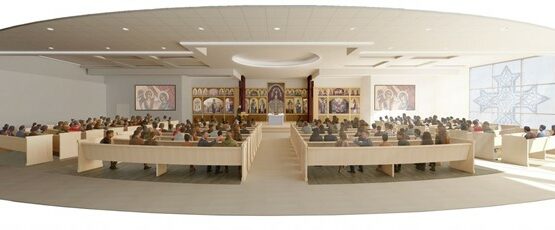
Currently, STSA Church meets in rented facilities in Arlington, Virginia. Blueline designed a new church building for STSA that has both a traditional Orthodox sanctuary and a contemporary “black box” auditorium with the capability to broadcast services to other locations. The facility also includes Sunday School classrooms, offices, a kitchen, and a roof-top gathering area. The church is anxious to move into its facility in early 2022.
“Having a permanent place of worship is vital to authentic Orthodox worship,” says Father Anthony. From the iconostasis to vestments to the use of incense and Holy Communion elements, the liturgy is full of symbols and stimulation for the senses, all aimed at celebrating the glory, power, and mystery of Jesus Christ. The contemporary worship venue will allow the church to live-stream to other locations. Orthodox Churches throughout North America can log into “The Well” service after their local liturgy. STSA also plans to host conferences and make their space available to other groups for meetings and celebrations.
When I asked Father Anthony what this ancient faith has to offer our modern world, he quickly responded, “Our ancient faith has solutions to all the problems of this world.” Father Anthony goes on to explain that we live in a world of unknowns, with lots of questions people cannot answer. Each Sunday, the liturgy celebrates a God who is both unknowable and mysterious yet has not left us alone. It recounts the Good News of God’s saving act in the death and resurrection of Jesus Christ and His abiding presence in the Holy Spirit. And the liturgy tells the stories of Saints through the ages who bear witness to a God that sustains us in a troubled world.
Blueline is grateful and honored to serve STSA and deliver a building that amplifies their mission to bring an Ancient Faith to a Modern World.
One of our clients has a sign posted in their foyer near where they serve coffee that says, “It’s not a meeting if there is no eating.” For many churches, food is the fuel of fellowship. Of the many things we miss in the age of COVID-19, sharing a cup of coffee or a meal together, at church, is near the top of the list.
Planning for how and where we serve food in our church buildings can be a challenging part of the overall design process. First, kitchens are expensive. They have a high concentration of utilities – plumbing, gas, HVAC – which makes the cost per square foot up to 50% higher than other areas of the church. Depending on capacity and quality, kitchen equipment can be a significant part of a project budget. In addition, building codes continue to roll out more and more measures to protect the health and safety of those who prepare, serve, and consume food in a church building. These technical factors combined with the passion many of us have for food and fellowship can make finding the right balance of capacity, functionality and cost difficult.
Twenty years of experience equips Blueline to help churches get the most out of their kitchens. Here are some lessons learned that can bring clarity to designing your food service areas:
“Commercial” vs. “Warming” — Churches usually describe the type of kitchen they want in one of these two terms. A commercial kitchen allows a church to cook food that generates grease, requiring a hood over any cooking surface or oven. This hood must have its own exhaust as well as make-up air. Production kitchens also need 3-compartment sinks connected to a grease interceptor with water at 140 degrees. Dishwashers must be high-temperature or use chemical sanitation. Food prepared for commercial purposes, including fundraising, trigger building code requirements that, in turn, require commercial grade equipment and construction.
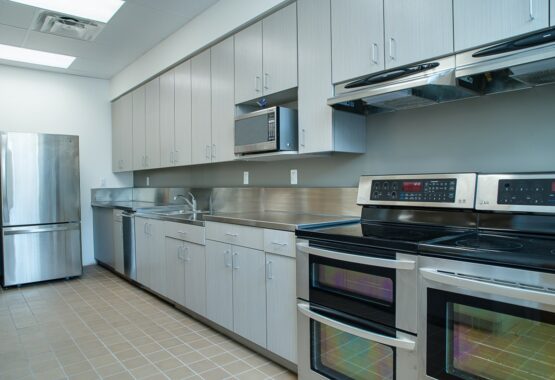
Warming kitchens typically employ residential-grade appliances. Food activities include warming items in a microwave, crockpot, range, or stove. Large, commercial grade convection ovens can typically be used for warming bread, pastries, etc. as long the reheating does not generate grease. Typically, we specify ample outlets and counter space for people to bring crockpots and provide multiple microwaves. A warming kitchen can also be a place for caterers to set up for an event that is being catered.
Building Codes vs. Health Department — The building code may be different than the requirements of your local health department. Churches are typically exempt from Health Department certification and inspections unless they are running a daycare or pre-school.
Flexibility — when the budget allows, utilizing stainless steel tables, shelving, and racks, rather than building permanent cabinets and countertops, allows for easier reconfiguration as use of the kitchen changes over time. Having some of the tables and shelving on castors allows groups to change the set up depending on the type of preparation need.
Workflow — There are time-tested ways for optimizing how people preparing and serving food move around the kitchen. It begins with a one-way flow with separate doors for entering and exiting the kitchen. The chart below shows a basic circulation diagram.
Other specialties that may be included in the kitchen are coffee production areas where large quantities of coffee are brewed and distributed to coffee service areas throughout the church. Churches that celebrate the Eucharist each Sunday often need a place to prepare the elements and store the trays, cups and platters associated with this sacrament. (This assumes there is no Sacristy.)
Also, do not forget the trash. Try to minimize the distance trash needs to be carried from the kitchen to dumpsters or outside trash cans. Recyclable materials – glass, plastic, cardboard, and compost – can take up a good deal of space. If carts are used for moving prepared food and/or dirty dishes, a space may be needed to wash the carts.
Size — A 20’ by 30’ (600 square feet) kitchen is ample size for a warming kitchen that serves several hundred people. A room this size can have worksurfaces and equipment around the perimeter with area for a 4’ wide by 10’ long island in the middle. A 15’ x 10’ room can accommodate storage of serving areas, dry goods, and bulk food items. The same footprint can work for a production kitchen depending on the amount of equipment and people working at one time.
Serving Windows — Some churches use serving windows for setting out food. This limits food service to one line. Serving from tables outside the kitchen allows two (or more) lines. It also frees up walls space in the kitchen for cabinets and shelving. Serving windows can be tricky to deal with if the kitchen must be enclosed with a fire-rated wall. Finally, eliminating the service window means there is no messy view from the dining/ fellowship area into the kitchen.
Kitchens are complex and expensive. Additionally, no two projects are alike. These are but a few of the many details Blueline can guide you through to discover the kitchen that best amplifies your hospitality ministry.