Author: Tessa Bennetch

  • Architecture in the A.I. Apocalypse

    Architecture in the A.I. Apocalypse

    By Ian Elmore, Designer | Published on March 1, 2023

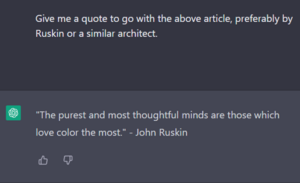
    “The purest and most thoughtful minds are those which love color the most.” – John Ruskin

    The past few months have seen exciting developments in the field of Artificial Intelligence (A.I.), also called Machine Learning.  Text-to-image A.I. like Stable Diffusion and Midjourney are causing a panic in the art world.  OpenAI’s ChatGPT is already causing shifts in copywriting, and software development. On the other hand attempts to bring an AI lawyer to court have floundered.  Universities have become an arm race between A.I.-authored term papers, and AI that detect A.I.-written term papers.  Headlines about a coming digital “apocalypse” stress the real threats that this technology can create.   It seems like every industry is talking of disruption as big as the advent of the internet, and the real implications of this technology aren’t clear yet.

    In my own explorations of this technology, I was shocked at how quickly these programs could create a personal portrait in the style of Van Gogh or rewrite a car manual in iambic pentameter.  Soon however, the limits start to become apparent: extra fingers, meaningless phrases, factual errors.  The computer can mimic what it has seen before, but on closer inspection the less it comprehends the subject matter.  It knows what shadows look like, but it does not understand where they come from.  With time you can pick up its patterns, and the results all seem to look the same.  It is another tool, and a tool does not have creativity and it does not have responsibility, those things come from how it is used. Once the novelty of new technology is past, it will only have the meaning that we put into it.

    But as architects and designers this is something we are used to. Our role, our value, has never been in laying the bricks or even producing the construction drawings. Design is the process that begins with helping a client define their needs, working together to craft it into a vision, and guiding that vision through realization.  A design professional understands what they are building and why it ought to exist.  AI offers exciting new opportunities, but it does not replace the process.

    Some of our staff started with hand-drawing production work, some started with 2d CAD software.  These days most of us work in a 3d BIM environment.  Within a lifetime we have seen complete shifts in the tools we use day to day, but the craft remains the same.  Many of us still sketch by hand, a quick sketch often communicating a concept better than a photorealistic rendering could.  This week I used StableDiffusion to quickly generate mural concepts for a project, but those will only be inspiration for a human artist.  I wrote this blog, but chatGPT picked the quote.  As design professionals, we look past the lines on the paper to what they represent, and what they will become.  That is the lasting value.
    Architecture in the A.I. Apocalypse

  • A Little Bit About Everything

    A Little Bit About Everything

    By Welby Lehman, AIA | Published on Feb 22, 2023
    So, you want to be an Architect?
    I’ll let you in on a little secret.
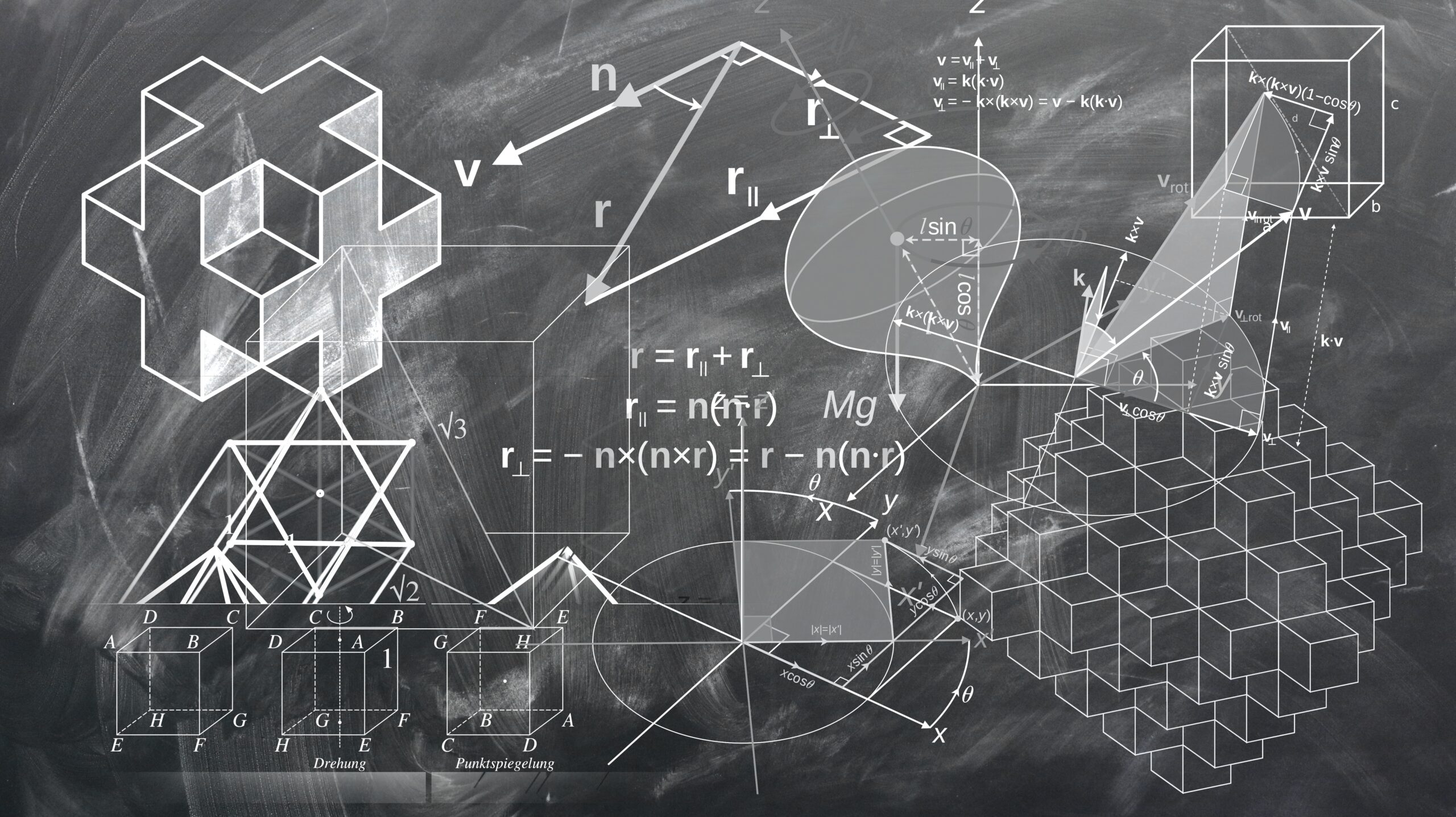
    Architects don’t do much math.
    Over the course of my nearly 15-year career, when my occupation comes up in conversation, I often hear people say, “I wanted to be an architect, but I didn’t think I could handle the math.” But the reality is, we don’t do much math.
    It is good for an architect to be comfortable with numbers. An architect occasionally uses basic algebra when plugging values into formulas and should understand concepts like perimeter, area, volume, angles, percentages, fractions, etc. But it is all middle-school-level math. We don’t use trigonometry or calculus. There are architects that design structural elements like foundations, beams, columns, etc. But most design teams include a structural engineer who handles that aspect.
    Before attending architecture school at Virginia Tech, I received my Bachelor of Arts Degree from Eastern Mennonite University in Mathematics. I had several semesters of calculus, probability, statistics, geometry, abstract math (don’t ask) among other courses. But I don’t use any of that now. The most helpful course for architecture was on statics, essentially the physical forces at work in structures that don’t move (which is really important for buildings). Later, in architecture school at Virginia Tech, I took more courses on structural design, which was the extent of the necessary math. These courses are a challenge for many architectural students. Fortunately for me, my undergraduate training made life easier.
    A good architect knows a little bit about everything, not just math or art. Here are some other subjects architects should grasp.
    A Little Bit About Everything
    Biology – The human eye, the human ear, and the human sense of comfort are all biological components affected by the built environment. Architects design better buildings when we understand them.
    Business – Architectural services must be provided in the context of a business with income and expenses, marketing, and other demands of the modern workplace. Architects need a handle on business principles to be able to keep doing their work.
    Chemistry – Buildings are made with the combination of many materials. Metals, concrete, paints, petroleum-based products, are just some of the materials which have a chemical composition that impacts their use in buildings.
    History – The best architecture understands its historical context in terms of location and in the arc of design through time.
    Physics – Gravity, wind, and earthquakes are some of the physical forces that buildings must resist.
    A Little Bit About Everything
    Philosophy – What is good? What is beautiful? Architects must use reason and logic when developing designs that function well with an immeasurable quality that we attribute to beauty.
    Psychology – Architects nearly always work for others and alongside others. As such, there are always personalities involved and an architect needs to navigate the group dynamics to keep the team working together for a successful project.
    Technology – Technology is always changing. Today we can use virtual reality to see a design or use programs to model a building’s energy use. This has significant impacts on how buildings are designed and constructed.
    Writing – The importance of communication cannot be overstated. Architects spend significant time in communication with others and most of that is writing; email, meeting minutes, notifications, contracts, just to name a few.
    So, don’t be fooled. Architects don’t do much math. Rather, we do some math but a lot of other stuff too!