Category: Uncategorized

  • Becoming an Architect: Starting the Great Adventure

    Becoming an Architect: Starting the Great Adventure

    The job market for architects is as good as it has ever been in the past 30+ years. Since founding Blueline in 2004, we’ve had the privilege of talking to many high school students exploring the profession. Here’s how to start the journey to joining one of the best professions.

    Becoming an Architect: Starting the Great Adventure

    Why Architecture?

    Architecture spans a wide range of interests and expertise. There is the creative rush of putting a pen to a blank piece of paper. For problem and puzzle solvers there is the intricate interweaving of materials and systems. We meet people stymied by the complexity and risk of a building project, guide them through the myriad of decisions and choices, then witness their wonder as their building takes form.

    Because architects see the big picture, foster collaboration, and think outside the box, we are uniquely equipped to tackle some of the world’s biggest problems. Whether it is climate change, affordable housing or new technology, architects lead in finding innovative solutions and opportunities.

    Becoming an Architect: Starting the Great Adventure

    Preparing for the Journey

    Architecture requires a college degree. This can either be a graduate or undergraduate degree. But the preparation for studying architecture begins before you graduate from high school.

    Most people assume that since there are significant technical components to architecture, it is logical to concentrate on math and science classes.  Others, seeing the artistic nature of design, assume art classes would be helpful.  There is value in having a solid foundation in both areas.

    But much of architecture is listening to people, understanding their ambitions and anxieties, and gaining their confidence. Learning how to speak and write clearly is essential.  Literature, history, and philosophy can help you understand the cultural context that shapes a person’s tastes and decisions.

    Travel is crucial. A person’s creative capacity is proportional to the number of places they’ve been and experiences they’ve had. And knowing another language makes travel even more impactful.

    We’re big advocates for construction experience. Even if your summer job was simply using a shovel or a broom, being around construction sites help you understand the priorities and needs of the men and women who make our drawings real.

    Becoming an Architect: Starting the Great Adventure

    The more well-rounded your knowledge and experience, the more you’ll get from your college education and the more options you’ll have as you enter the workforce.

    The Arc of a Career

    Graduating from architecture school is only the beginning. Much of what you’ll need to know, you’ll learn on the job during the first several years of your career.  Look for a firm committed to mentoring and equipping you to take your architectural registration exam (ARE).  In your first three to five years, work for two or three different firms. Try big firms and small firms. Try firms that do different types of work. If the firm keeps you in front of the computer, go to job sites on your lunch break or weekends. Continue to read, travel and be curious.

    Some of you may be content designing and creating construction documents. Others will be happiest working with contractors and being on the jobsite. Some of you will shine when you are in front of clients. You can manage, sell, or teach. The permutations are endless.

    Blueline provides job shadowing for ambitious high school juniors and seniors. Our team comes from all over the world and would be happy to talk to you about starting this journey. Visit our website www.blueline.team. We’re happy to connect you with the right staff person to answer your questions and help prepare you for this rewarding profession.

    Randy Seitz, AIA
    President | Architect
     

  • Overcoming Obstacles

    Overcoming Obstacles

    We’re just a few short weeks past the latest Super Bowl. Some of you watch it for the game, some for the halftime show, and some for the commercials. I personally didn’t feel strongly about either team—I was just hoping for a good game that wasn’t over by the second quarter. To that end, the game didn’t disappoint.

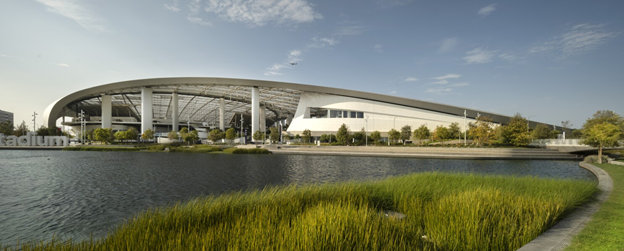
    The architect in me, however, was interested in the stadium. On television, SoFi stadium looks like any other stadium out there; one hundred yards of playing field with goal posts at each end, completely surrounded by tens of thousands of screaming fans, watching twenty-two players battle for sixty minutes to get the Lombardi trophy (and the trip to Disney World). The view on TV didn’t do the facility justice—there’s way more to it…

    Most professional sports stadiums are large behemoths surrounded by vast swaths of parking that tend to take over the area of the city where they’re located. SoFi is different in that it’s the centerpiece of a larger development – Hollywood Park. In addition to the stadium is the YouTube theater, which is connected to the stadium by the American Airlines Plaza; all of which are covered by a single sweeping roof structure. Other development on the site includes roughly 25 acres of public parks, green space, and a lake. 

    Overcoming Obstacles

    Adding to the complexity of an already challenging building is the fact that with its proximity to LAX, there are height restrictions imposed by the FAA. At first glance, this would seem like a project killer. Stadiums need to be tall to provide room for an adequate amount of seating to help justify the project cost, right? Normally, yes, that’s the way it’s always been done. I’m sure it would’ve been easy to say “It’s not possible. Find a new site and then we’ll talk.”  Luckily, that wasn’t the case. Some good, old-fashioned out of the box thinking found a way to meet the challenge—by burying the stadium in the ground.

    Overcoming Obstacles

    Placing the playing field roughly 100 feet below the exterior grade limited the height of the structure to meet the FAA requirements, while still providing a stadium worthy of the Super Bowl (and upcoming Olympic games). Much thought was put into the design to ensure that while being in the ground, the stadium doesn’t feel cavernous. This was accomplished primarily by means of a semi-transparent roof structure that is self-supporting and not connected to any walls, allowing both natural light and ocean breezes to permeate the space.

    I can guess what you’re thinking. Why is a firm that has no large stadiums in their portfolio spending so much time talking about a stadium? Besides the fact that as an architect, I geek out on such things, there is a larger point to make. It illustrates the value of Architects and their design teams. Positioned firmly at the intersection of art and science, Architects are uniquely qualified to provide the creative, out-of-the-box problem-solving that allows difficult obstacles to be overcome. This lays the groundwork for a building that meets client’s needs, represents them as an organization, and amplifies their mission and vision, giving them a home that’s uniquely theirs.

    In the words of one of my architecture professors, “They’re not obstacles, they’re opportunities.”

    Mike Wittig
    Senior Project Leader | Architect
  • Product Spotlight: J+J Invisions Kinetex

    Product Spotlight: J+J Invisions Kinetex

    “The Benefits of Soft Surface with the Performance of Hard-Surface”

    Product Spotlight: J+J Invisions Kinetex

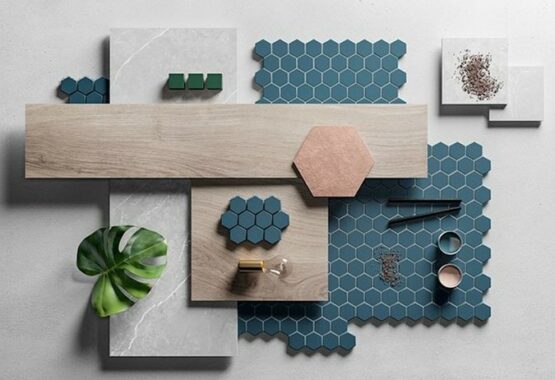
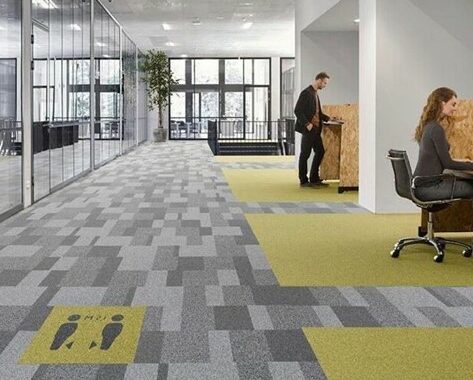
    When deciding what type of flooring to install in a space, the first step is to answer the question, “What activities will the flooring need to support”. A soft surface, like carpet, can provide slip resistance, noise control, and enhanced temperature control. A hard surface, like LVT, luxury vinyl tile, can provide superior cleanability and crush resistance. However, there are plenty of spaces, such as dining facilities or multipurpose rooms, that require all the above. J+J Invisions has created a product to do just that; provide the benefits of a soft surface with the performance of a hard surface. Kinetex flooring provides a durable, low maintenance floor with health, safety, and acoustic benefits, all while providing comfort to its occupants.                       

    Durability

    When put to the test, Kinetex delivers enduring performance. Its dimensional stability and crush resistance allow this product to withstand heavy use without compromising product quality. Heavy furniture will not crush the fibers and consistent foot traffic will not wear down the color or thickness.

    Product Spotlight: J+J Invisions Kinetex

    Maintenance

    There’s no special training required to maintain a Kinetex floor. The maintenance is similar to carpet, in that it only requires vacuuming with the periodic encapsulation cleaning. Due to the lightweight construction, Kinetex dries 75% faster than carpet and retains less water. It’s limited ability to retain water allows for quick clean up and resistance to most staining agents like coffee, ketchup, and food grease.

    Health

    Airborne particulates enter our spaces every day. These particulates are what trigger allergies and cause infections. When the particulates hit a hard surface they are easily redistributed through foot traffic and circulate into our “breathing zone”. When these particulates hit a Kinetex surface they are trapped until they can be removed by cleaning.

    Product Spotlight: J+J Invisions Kinetex

    Safety

    Risks of slips, trips and falls can pose an immediate threat to people of all ages, and most are avoidable with consideration to flooring selection based on the specific needs and requirements of the building. Several tests are completed to determine a material’s coefficient of friction. The higher the coefficient of friction the lower the risk of slips. Kinetex is certified as high-traction by the national floor safety institute and considered the most slip resistant surfaces tested.

    Product Spotlight: J+J Invisions Kinetex

    Acoustics

    When sound waves hit a hard surface, they are easily bounced back into the air creating a noisy environment. When sound waves hit a soft surface, the surface absorbs some of these waves creating a quieter environment. Due to the knitted fabric of the Kinetex flooring, Kinetex can absorb some of these sound waves offering an improved occupant perception and focus.

    Product Spotlight: J+J Invisions Kinetex

    Comfort

    Kinetex’s high-density backing and soft textile surface provides antifatigue properties along with minimal rolling resistance. It embodies the potential to absorb energy and reduce both repetitive foot stress injuries and injuries related to walking and moving frequently from place to place. With its thermal insulation properties, Kinetex also provides a warmer indoor environment.   

    Product Spotlight: J+J Invisions Kinetex


    Houwman, C. (2020, June 11). What is Kinetex? high-performance soft-surface flooring. J+J Flooring Group. Retrieved January 31, 2022, from https://www.jjflooringgroup.com/what-is-kinetex/

    Kristin LaPorta, NCIDQ, ASID
    Interior Designer

  • Four Design Features Higher Education Students Will Love

    Four Design Features Higher Education Students Will Love

    Four Design Features Higher Education Students Will Love

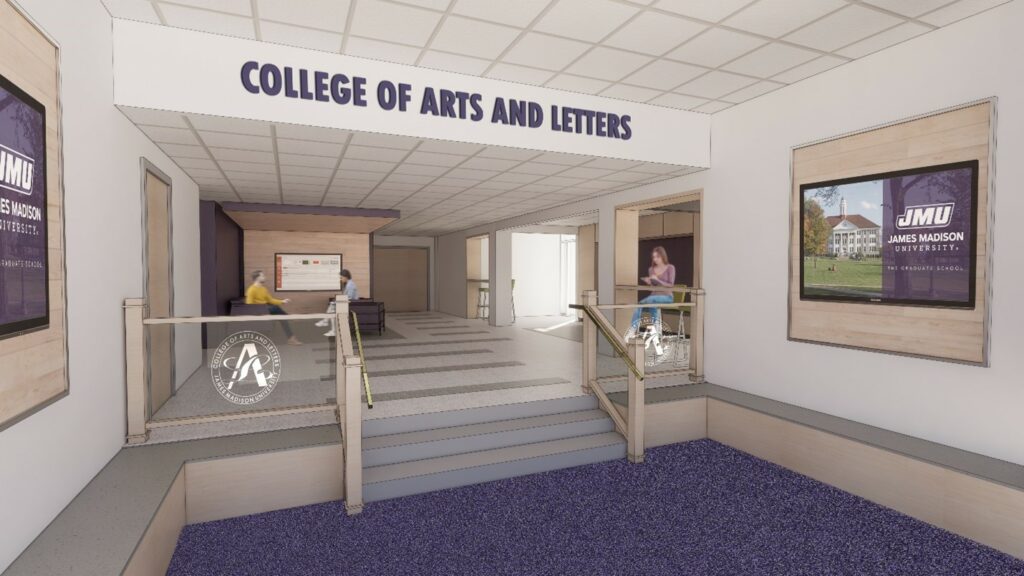
    1. Photo Worthy Design Features – Taking and sharing photos on social media has become almost instinctual for students of this generation; it’s all about finding what is Instagram-worthy. For example, millions of people travel from across the world to take pictures at iconic places like the Eiffel Tower in Paris, France, Cloud Gate “The Bean” in Chicago, Illinois, or the Statue of Liberty in New York, New York. We can use architecture and design to recreate this concept on a smaller scale by creating iconic moments around your campus. Whether it be a cascading multistory feature wall in a lobby, an interesting staircase, or a historic building on campus, these “photo-worthy” design features can help your school stand out among others by catching the eye of students who are touring a half-dozen or more campuses.

    2. Community Space at a Smaller Scale – Large communal spaces have always been a growing trend in higher education design, but COVID-19 has forced colleges and universities to accommodate smaller numbers while continuing to foster a sense of community. One way to achieve this is by finding underutilized spaces within your existing floor plan to create “pockets” for smaller communal spaces. These spaces can then be reserved by small groups of students for study or collaboration sessions during scheduled timeslots. By providing several smaller gathering spaces around your campus rather than one large communal space – we can still encourage collaboration, but do so safely.

    3. Space to Focus – While providing community areas is important for collaboration, providing focus areas is just as important when designing university spaces. For students who focus best in an environment with buzzing background noise, a café may be the perfect place. For others, who require quiet time with minimal distraction, it is important to provide private breakout spaces. When designing a classroom building—whether new construction or renovation—make sure to carve out space for small – one person – rooms that provide students a place to step away from distraction. If you are working within an existing space where moving walls isn’t an option, you can create these quiet spaces with furniture.

    4. The Ability to Work Anywhere – Now, more than ever, students expect to be able to do their work nearly anywhere. Whether in a classroom, lounge, coffee shop, or in the hallway between classes, it is important to equip your space with mobile technology and provide flexibility to students wherever they need it. This can be as simple as integrating power into a built-in bench or creating breakout areas equipped with tv monitors for students to collaborate in small groups. The design of your space should make it easy for students to create, interact, and share-content in real-time.

    Kirsten Weston
    Design Associate

  • How Furniture And Signage Affect The User Experience

    How Furniture And Signage Affect The User Experience

    Imagine you have a brand-new space that you and your team have poured your hearts and souls into. The programming has been meticulously analyzed. The views have been optimized, and the finishes are in pristine condition.  You start imagining the growth and fellowship that is about to take place between these freshly painted walls. Then it hits you, while you know this new building like the back of your hand, will your visitors feel just as comfortable?  

    Most of us can agree that navigating a new space can create some anxiety. “Will I be able to get where I’m going?” Will I belong?” It is a designer’s job to help ease some of these anxieties and curate a positive experience for all visitors. Signage and furniture tend to be afterthoughts, but it is the furniture and signage that send the clearest message to the visitors of a space. Let’s look at what subconscious messages we are sending. 

    Signage – “We’ve been expecting you” 

    How Furniture And Signage Affect The User Experience

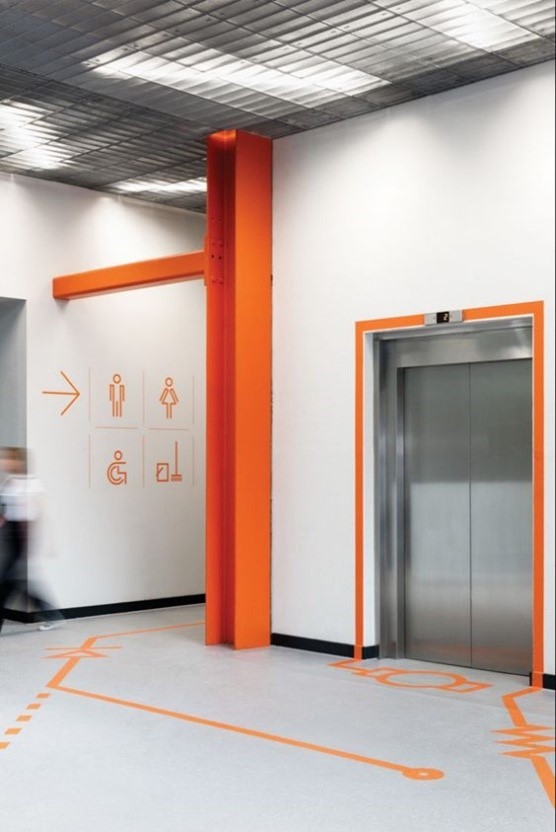
    When a complete signage package is integrated into the initial design of your space, not only does it create an overall cohesive look, but it also sends the message to visitors that this space was created with them in mind. It is important to remember that not all visitors have the same needs. You will have visitors of all ages and backgrounds that may not read a sign the same way. The use of pictures and color-coded wayfinding are a great universal way to guide people. Nothing creates more inclusivity than sending the message “We’ve been expecting you.” 

    Furniture- “We are here to meet your needs

    How Furniture And Signage Affect The User Experience

    Upon entering a space, visitors should quickly “feel” the type of space they are entering by the furniture arrangements. Imagine you have just walked into a 30’x30’ room. This room has a concrete floor, white walls, and is completely empty. You’re asking yourself, “What do you do in this space?” Most likely you’re looking around for visual cues on how to respond to your surroundings. Then, imagine you have walked into a 30’x30’ room with a concrete floor and white walls, only this time you see a cluster of café tables and stools all centered around a small barista station. The tables and chairs tell you this is a place to socialize, and the barista station tells you the function of the space.  

    We can continue to curate the experience by furnishing the space with a combination of table and chair styles. Bar height tables and low back stools encourage interaction between guests by placing seated guests and standing guests at eye level.  The low back stools allow for easy movement from left to right and from standing to sitting. By including a seating arrangement with dining height tables and higher backed chairs, you are inviting your guests to spend more time in the space. The variation in styles sends the message to guests that “we are here to meet your needs.”   

    Through thoughtful furniture arrangements and clear messaging, you are putting your visitors’ needs first, thus communicating a message of acceptance and hospitality. 

     
    Kristin LaPorta 
    Interior Designer | ASID | NCIDQ | LEED AP

  • Transitions – Portable to Permanent (Part 2)

    Transitions – Portable to Permanent (Part 2)

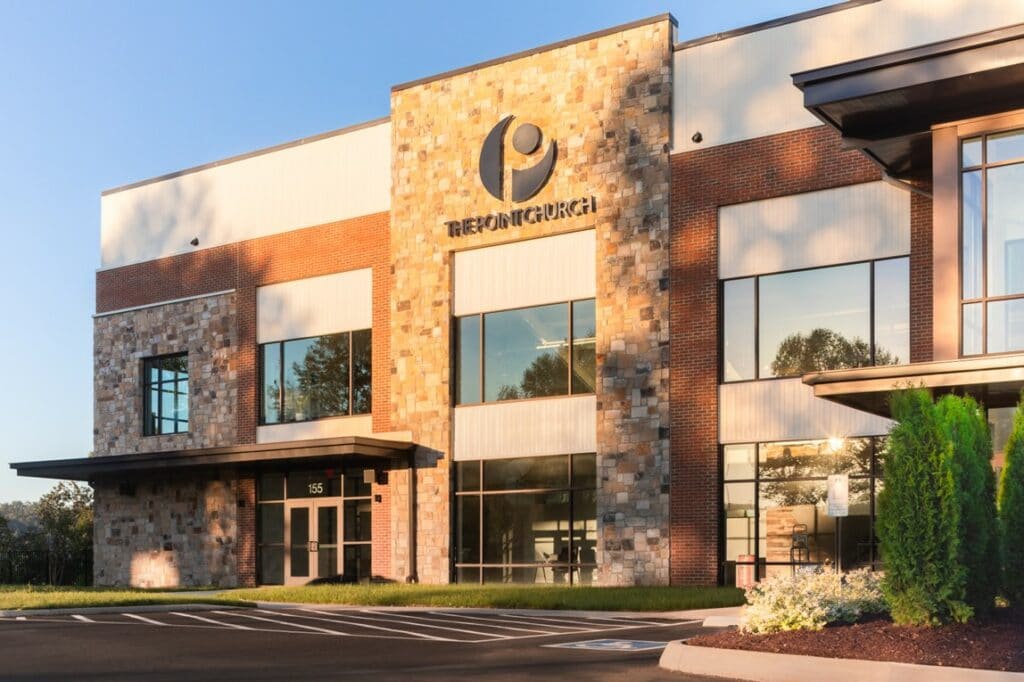
    This is the second part of a conversation I had with Jessie Wilson, Director of Operations for The Point Church in Charlottesville, VA, about their journey going from portable to permanent. After spending 10 years operating as a portable church, The Point acquired property and built from the ground up, opening their permanent home in September 2020. Part 1 covered their time being portable and the decision-making process to move toward a permanent home. In this post, we discuss life in their new facility.

    Transitions – Portable to Permanent (Part 2)

    You’re now in your new home.  Overall, how has the experience been?

    As somebody who has overseen operations for the church for the last six years, it’s a whole new world. It’s definitely a mind shift to go from thinking, “Alright, I’ve got two hours of set up, two hours of teardown, with two church services in between” to being able to direct most of your focus to the service itself.

    Even for our congregation, it feels like home; like we’ve arrived. And they have the sense that it’s our church–it’s not Monticello High School that we put our church into for a few hours on Sundays—it’s our church. So, it gives ownership to our people. It’s awesome. I don’t know any other way to say it other than it’s awesome.

    How has volunteering changed?

    There’s still some amount of set up and tear down, but it’s looks very different. It allows people to focus more energy on their specific gifts. 

    We now have a building to maintain which has allowed us to start a mentorship program where we pair older members that have certain gifts or skillsets with younger members.  For example, in setting up our Kidspoint environments, there was a great opportunity for the younger guys in our church to learn from our older members and get hands on experience in building furniture. Additionally, a Christ-based relationship is formed, where later on, the younger member can lean on the older one for advice in dealing with issues that may come up in their lives. This was a huge opportunity for our church body to have a great mentorship program where you don’t even realize you’re in a mentorship program. You’re just hanging out with the guys.

    Transitions – Portable to Permanent (Part 2)

    Have you had any unexpected benefits from having a permanent home?

    There have been a lot of things. I think the overall thing that I’ve been impressed by and have loved so much is the ownership that our church body has taken in it. 

    We’ve had a number of opportunities that having a permanent building has given us. For example, a couple of months ago, we teamed with local restaurants and fed twelve hundred meals to health care workers on a Wednesday night—the building allowed us to do that.

    Sometimes people will come and sit in the parking lot simply to enjoy the view.

    We’ve had people come to us asking for help, which we didn’t experience before because outside of Sunday mornings when our signs were out and visible, people didn’t know where to find us. Having a permanent facility has allowed us to become more of a fixture in the community. For instance, a couple of months ago there was a lady whose car broke down. Having seen the sign on our building, she knew that we were here, and we were able to help her. So, it just expanded our ministry to another level that we didn’t have before.

    What advice would you give another church that was considering a permanent home?

    Do it.  I think it’s a great move. It redirects the energy that you’re using on setup and teardown and the other aspects of being portable into other areas and allows you to expand your ministry in other places.

    Don’t build to accommodate your current attendance—always project for growth.

    Use the move as an opportunity to build off past experience while still maintaining your identity. As a portable church, we learned to be scrappy out of necessity, and I hope we never lose that. At the end of the day, we’re still The Point.

    Blueline has been honored to serve The Point and are excited to hear about the opportunities and positive outcomes that being in their new building has given them.

    Mike Wittig 
    Senior Project Leader | Architect

  • Transitions – Portable to Permanent (Part 1)

    Transitions – Portable to Permanent (Part 1)

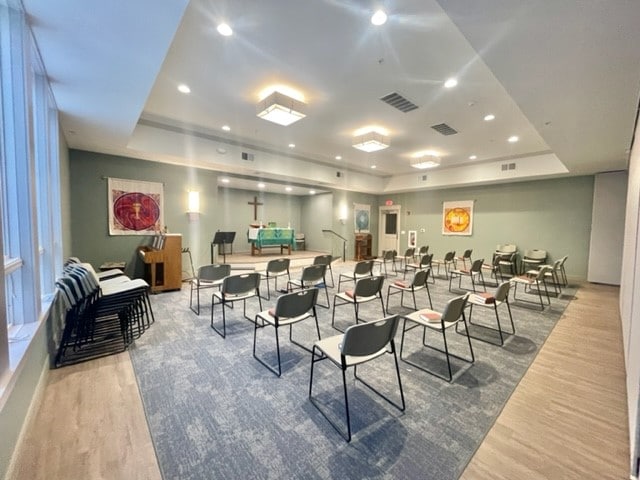
    It’s a natural progression for a young church.  After forming, one of the early needs is finding a place to meet that allows the church to minister to the community and hopefully grow.  Historically, schools have provided a nice fit, in that they’re usually empty on Sundays when a church would need them, they have rooms that lend themselves nicely to worship and children’s ministries and are a cost-effective way to allow a church to grow in a fiscally responsible manner. 

    Each church is different, but for most, the next logical step is to move on from the portable setup to a more permanent one – whether converting an existing building to a church or building new from the ground up. I recently spoke with Jessie Wilson – Director of Operations for The Point Church in Charlottesville, VA about their journey going from portable to permanent.  After spending 10 years operating as a portable church, The Point acquired property and built from the ground up, opening their permanent home in September 2020.

    Transitions - Portable to Permanent (Part 1)

    You’ve been in your new facility for nine months now.  After having a little time to reflect, when you look back, what is your overall perception of being portable.

    There were challenges.  Our venues were great to be in but having your 24/7 facility in five trailers Monday through Saturday didn’t allow for your equipment and belongings to last very long.  With constant packing and unpacking, things wore out…every week it seemed like we were replacing something. So, the list of complications in doing portable church could be long.  On a positive note, however, it also makes you scrappy—which is something that I hope we don’t lose going forward—and it made our volunteer teams a lot tighter than they would’ve been otherwise.

    With portable church relying so heavily on volunteers, was it difficult to maintain enthusiasm?

    One of the things that is very important to us is that you serve using the gift(s) that God has given you. Now, your gift can be in setup and teardown where you use your hands, and that’s how you serve the church.  However, what we noticed while portable was that people who were gifted in other areas (like kid’s ministry) were helping with setup and teardown out of a sense of obligation, which could lead to burnout at times.

    Being permanent (with less need for setup/teardown) has allowed our church body to dive deeper and serve using their specifics gifts instead of serving in other areas out of a sense of obligation because they knew that somebody had to do it.

    Transitions - Portable to Permanent (Part 1)

    After a while, did you begin to get questions from within your congregation about whether a permanent home was part of the future?

    No, from the very beginning, we’ve always known that we were aiming for a 24/7 facility, and constantly casted that vision to the congregation to keep those questions from arising.  We didn’t always know what it looked like, but the messaging was maintained from day one.

    How was the decision made to pursue a permanent home?  What drove the timing?

    It wasn’t like we waited and said at the 10 year point we’re going to build our first 24/7 facility… From day one, leadership started looking for a permanent home, with the goal of moving in as soon as we found the right place.  As we grew, we knew we needed to speed up the process. We looked at a lot of storefronts and a lot of different properties, but the Lord shut the door multiple times. 

    Meanwhile, growth continued to occur to the point that we were literally bleeding into the hallways, setting up kid’s environments because we were growing faster than the space would allow. We considered starting a third service because we were filling the auditorium to max capacity on both services every single Sunday.

    Finally, the right opportunity opened up and we pursued it.  Looking back, the timing and the growth went along with each other, but I would say the timing was on the Lord.

    In our next post, we’ll discuss life in a permanent facility, opportunities that have been opened for them, and some of the unexpected benefits they’ve experienced since being in their new home.

    Mike Wittig
    Senior Project Leader | Architect
     

  • Three Better Ways to Select a Contractor – Construction Manager as Constructor

    Three Better Ways to Select a Contractor – Construction Manager as Constructor

    Several weeks ago, we introduced the idea that there are better ways to select a contractor than to ask contractors to submit bids at the end of the contract documents phase. In a subsequent post, we discussed the pros and cons of design/build. Today we look at a project delivery method known as Construction Manager as Constructor (CMc).

    In this method, an owner hires both the architect and the CMc at the start of the project. If the architect is hired first, they can assist the owner in interviewing, evaluating, and selecting a construction manager.  The reverse can happen as well – an owner hires a CMc, and they assist in hiring the architect. In either case, each company has a separate contract with the owner.

    Three Better Ways to Select a Contractor – Construction Manager as Constructor

    The American Institute of Architects (AIA) contract language[1] places responsibility for establishing the project budget and schedule with the CMc. As the architect develops design concepts and produces the contract documents, the CMc provides estimates and ideas for modifying the design to stay on budget.  The CMc also advises on issues of constructability – which are the best materials and systems to use given the projects, program, budget, site, and schedule.

    Once the design is done, the CMc prepares a guaranteed maximum price (GMP) which is the contractual cost of the building.

    Pros:

    • The construction manager’s knowledge of the most economical materials and systems is available from the start of the project.
    • Creates a collaborative ethos between construction manager, architect, and owner.
    • The construction manager can leverage relationships with sub-contractors to provide additional information regarding cost, schedule, and constructability.
    • Can facilitate fast-tracking projects.
    • Guaranteed Maximum Price format is open book, allowing for owner input on sub-contractors.
    • The owner has direct access to architect and their consultants throughout both design, and construction phases.
    • Cost-creep throughout construction is minimized.

    Cons:

    • Execution of a project under a GMP requires more record-keeping and information management.
    • Construction management works best on larger projects.
    • The construction management firms need to have dedicated pre-construction staff with skills in estimating, scheduling, and constructability reviews.
    • This method of project delivery does not typically save money on fees.

    If you want the expertise of a contractor as part of your project team from the start, let Blueline help you find and select the right construction manager.


    [1] You can learn more about the actual AIA agreement at https://www.aiacontracts.org/contract-documents/6232027-owner-construction-manager-as-constructor-agreement